

I drove trucks cross-country for nineteen years. You sleep when you can, where you can, and often not well. By the time I was 51 I had two speeds: wired and exhausted. A buddy in my dispatching group swore by his weighted blanket and I figured at the price of the YnM, I had nothing to lose but another bad night. I got it wrong the first time. And the second. On the third try, after I actually read what I was doing, I started sleeping through the night for the first time in years. This guide covers what I learned the hard way, so you can skip to the part where it works.
A weighted blanket works through a principle called deep pressure stimulation. The steady, distributed weight across your body signals your nervous system to calm down. Your cortisol drops. Your serotonin rises. For people with racing thoughts or chronic light sleep, that physical cue to relax is something a pill can only imitate. But none of that works if you pick the wrong weight or use it in a way that fights your body instead of helping it. The YnM 15-pound blanket is what I landed on and what I recommend for most average-sized adults. Here is exactly how to use it.
If you are lying awake grinding your teeth at 1am, this is the tool that finally stopped it for me.
The YnM 15-pound weighted blanket uses premium glass beads sewn into individual grid pockets so the weight stays even across your whole body. Over 49,000 reviews on Amazon. Check today's price before you read another word about sleep tips.
Amazon Check Today's Price on Amazon →Step 1: Pick the Right Weight for Your Body
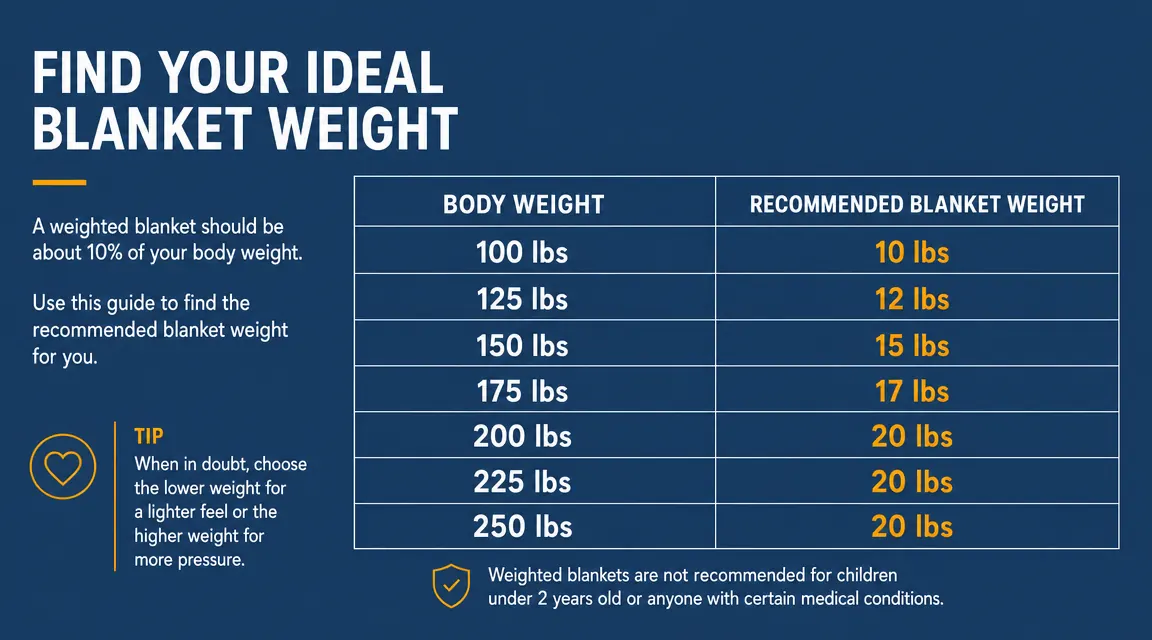
The rule you will see everywhere is 10 percent of your body weight. That is a reasonable starting point but it is not a hard law. I weigh 185 pounds. Ten percent would be 18.5 pounds. But I found 15 pounds more comfortable for all-night use. Here is why: the 10 percent rule is designed for therapeutic use in clinical settings, often for shorter sessions. For sleeping through an entire night, most people find that 10 percent is slightly too heavy and causes them to shift around or kick the blanket off. I recommend starting at 7-8 percent of body weight if you have never used one before, then moving up from there if you want more pressure.
Use this as your baseline. Under 130 pounds: try a 10-pound blanket. 130 to 160 pounds: 12 to 15 pounds. 160 to 200 pounds: 15 pounds is the sweet spot for most. Over 200 pounds: 20 pounds is typically the ceiling you want before it starts interrupting circulation or feeling restrictive. Children should never use a weighted blanket without a pediatrician's guidance. The YnM comes in multiple weight options so match your size before you order.
Step 2: Understand How the Glass Beads Work (and Why It Matters)
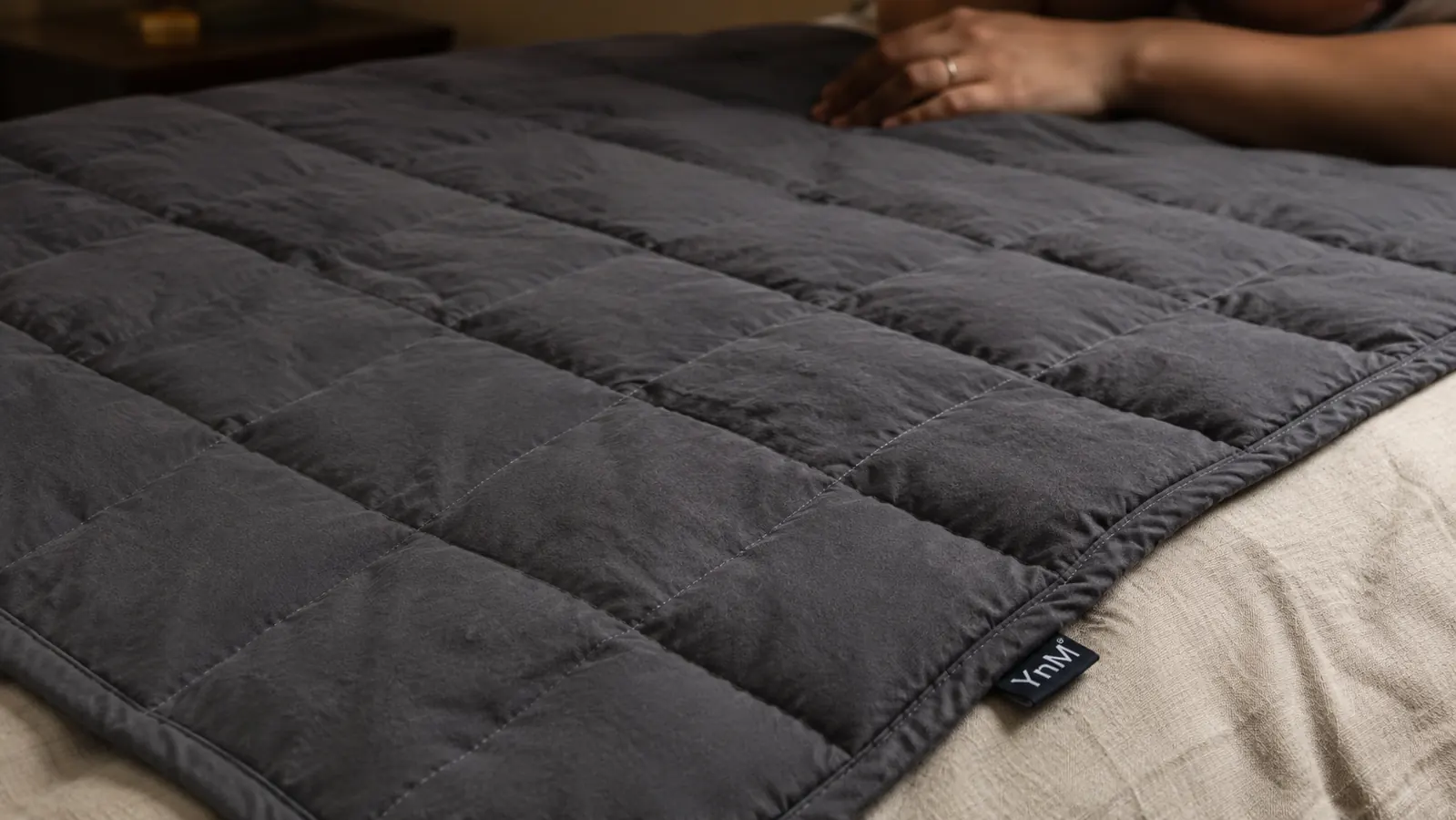
Cheap weighted blankets fill the pockets with plastic pellets or steel shot. Plastic pellets clump over time and create uneven pressure, which means you get a lumpy 8 pounds in one spot and almost nothing in another. The YnM uses premium glass beads sewn into a 7-layer construction with individual grid pockets. Each pocket is roughly 4 inches square. That design is what keeps the weight distributed evenly from the center of your chest to your ankles. When the weight is even, the nervous system response is consistent. Uneven weight is uncomfortable and trains your brain to fight the blanket instead of relax into it.
The glass beads also stay quieter than plastic pellets. When I first tried a cheaper brand, every time I shifted I could hear a faint rattling that woke me up a little more. The YnM beads are nearly silent. That matters at 3am when your brain is looking for any excuse to stay conscious. Check the stitching on your blanket when it arrives. All grid seams should be tight with no loose threads. If a seam fails, beads will migrate into adjacent pockets and you lose the even distribution.
Step 3: Layer It Correctly on Your Bed
Most people throw a weighted blanket on top of their regular covers and wonder why it feels wrong. The weighted blanket should be your primary cover, not an addition on top of a pile. If you layer it over a thick comforter, the comforter lifts the blanket away from your body and breaks the contact. The weight ends up sitting above you rather than on you, which means the pressure is diffused and you lose half the benefit. Use the weighted blanket directly on your body with a light sheet underneath for warmth regulation, or use it alone if your room is warm enough.
Lay it so the center of the blanket sits at your chest and the bottom edge reaches your feet. Do not pull it over your head or face. The pressure is designed for your torso, legs, and arms. Covering your face interferes with breathing and creates heat buildup that will wake you up. Some people find tucking the side edges under the mattress helps keep it in place through the night. I do this on one side because I move in my sleep and it keeps the blanket from ending up on the floor by 2am.

Step 4: Give It a Full Two-Week Adjustment Period
Here is where most people quit too early. The first two or three nights under a weighted blanket often feel strange. The weight is new. Your body is not used to it. You might feel slightly warmer than usual. You might shift around more trying to find a comfortable position. None of that means the blanket is not working. Your nervous system needs time to learn that the pressure is safe and calming rather than something to fight. Sleep researchers call this a sensory adaptation period. Most people who quit before two weeks never gave themselves a real trial.
My first three nights with the YnM I woke up twice each night. By night five I was down to once. By night ten I was sleeping through. The key is to not abandon it during the adjustment window. If the weight feels genuinely too heavy and you cannot sleep at all, that is a signal to go down in weight. But if it just feels new and a little unusual, stay with it. Keep a simple log of how many times you wake up each night. Most people see a clear downward trend over the two-week period and that progress helps them stick with it.
Most people quit after three nights. The adjustment window is ten to fourteen nights. You are not failing, your nervous system is just learning something new.
Step 5: Combine It With These Other Habits for Full Effect
A weighted blanket addresses the physical side of sleep anxiety but it works best when you remove the other things that are working against you. Room temperature is the biggest one. Your body drops its core temperature to fall asleep. If your room is warmer than 68 degrees Fahrenheit, you will fight that process no matter what you are sleeping under. Keep the room cool and let the blanket provide warmth from body contact rather than insulation. The YnM's cotton outer layer breathes reasonably well, but it is not a cooling blanket. Pair it with a lower room temperature rather than expecting the blanket itself to manage heat.
Light is the second one. If any light hits your eyes during sleep, your brain interprets it as a signal to wake up. Blackout curtains or a good sleep mask solve this completely. I use both. Sound is the third factor. If you live near highway noise, have a partner who snores, or deal with thin apartment walls, a white noise machine running near the bed creates a consistent audio environment that masks the interruptions. The weighted blanket handles your nervous system. Temperature, light, and sound handle the environmental inputs. Fix all four and you are giving yourself the best possible conditions.
Screen time is worth addressing too. The blue light from phones and tablets suppresses melatonin for up to two hours after you stop using them. If you are watching videos in bed right before sleep, the weighted blanket is competing against a biological signal telling your brain it is still daytime. Put the phone down at least 45 minutes before you plan to sleep. I know that sounds like obvious advice but it took me a long time to actually do it, and the difference was immediate. The blanket works faster when your melatonin is not being suppressed.
What Else Helps
If you have read the full YnM weighted blanket review, you already know how it performs over a long stretch. But the how-to of sleep improvement is bigger than any single product. The weighted blanket handles deep pressure stimulation and nervous system calming. Magnesium glycinate, taken about 60 minutes before bed, supports the same GABA pathways the blanket engages physically. A consistent wake time, even on weekends, does more for sleep quality than almost any product. Your circadian rhythm runs on light exposure and schedule consistency. Products fill gaps. Habits build the foundation.
If racing thoughts are your specific problem, the 10 reasons a weighted blanket helps quiet racing thoughts article goes deep on the mechanism. The short answer is that your nervous system cannot ruminate as effectively when it is receiving strong physical input. The blanket gives it something concrete to process, which interrupts the loop. That is not a cure for anxiety or clinical insomnia, but for the everyday version of a brain that refuses to shut off, it is a surprisingly effective tool.
Washing the YnM is straightforward. Cold water, gentle cycle, low heat dry or air dry flat. Avoid hot water because it can weaken the pocket stitching over time. I wash mine every two to three weeks. It comes out of the dryer slightly stiff for the first hour and then softens back to normal. If you notice any pocket seams looking loose after washing, reinforce them with a few stitches before they fail and beads start migrating.
49,000 people found something that finally helped. Here is the blanket.
The YnM 15-pound weighted blanket is what I recommend for most adults between 140 and 200 pounds. Glass beads, even grid distribution, quiet at night, and priced so low that trying it is a no-risk decision. Check today's price and available weight options on Amazon.
Amazon Check Today's Price on Amazon →